How to pronounce The /t/ as in TEN /t/ in American English
One of the most common consonants in American English. Hear it in time, top, test, take.
The American /t/ shape-shifts more than almost any other consonant in English. Its pronunciation changes depending on what's around it. Between vowels with the second one unstressed (water, butter), it flaps into a quick D-like sound. Before an N at the end of a word (button, certain), it closes off into a glottal stop. After an N (interview, internet), it often drops out entirely. The 'crisp' textbook T mainly survives at the start of a stressed syllable, like top, take, or test.
Three small adjustments.
Get them right and the sound takes care of itself.
Touch the tip or front edge of your tongue to the roof of your mouth just behind your teeth. Keep your jaw relaxed. Stop the air, then release with a puff.
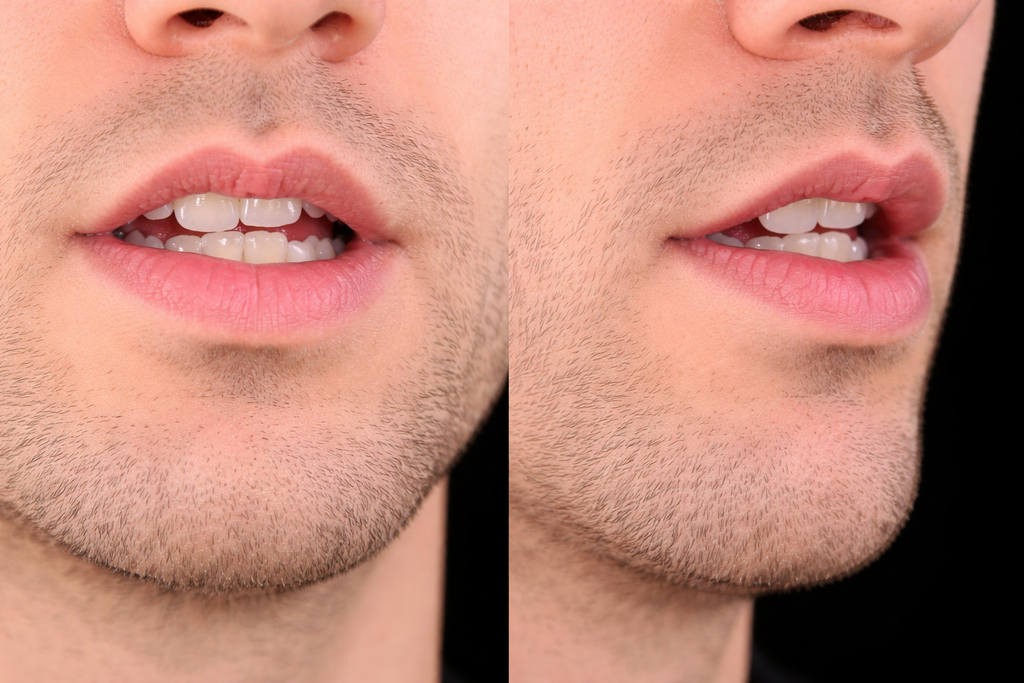
Mouth shape
/t/ as in time
Tongue
The tip or front edge lifts to the roof of the mouth, far forward, touching just behind the upper front teeth.
Lips
Part slightly for the release burst.
Two things to remember.
At the start of a stressed syllable, True T has a puff of air (aspiration). After /s/ (as in stop, start), the puff disappears.
Same mouth position as D (/d/) but without vocal cord vibration.
16 everyday words.
Tap any word for its full breakdown — every reduction, every flap-T.
In real conversation.
5 short sentences where this sound shows up. Tap to play; click the title for the full breakdown.
Connected-speech rules involving /t/.
Each rule has its own page with examples and practice tips.
Flap T
/t/ or /d/ becomes a quick tap [ɾ] — sounds like a soft D. The tongue briefly taps the ridge behind the upper teeth.
Rule 02Glottal T
/t/ becomes a glottal stop [ʔ] — a catch in the throat. The schwa in the following syllable is dropped, making the nasal syllabic.
Rule 03Silent T after N
/t/ is completely silent — the tongue skips the T stop and moves directly from the N position to the next sound.
Rule 04Silent T in Clusters
/t/ is dropped entirely — the surrounding consonants flow together without the T.
Rule 05TR Sounds Like CHR
/t/ shifts toward /tʃ/ ("ch"), so TR sounds like "chr".
Rule 11Unreleased Stops
Air stops but there's no release burst — the articulators hold position.
Rule 15Y-Merging (gotcha, didja)
The two sounds merge: T+Y → CH, D+Y → J, S+Y → SH, Z+Y → ZH.
Rule 16Flap T Across Words
Same flap as within-word (R1) but spanning two words.
Common questions about /t/.
Why does the T sound so different in "top" vs "water"?
Is the T silent in "internet"?
What's a glottal-stop T and when does it show up?

Practice /t/ with an AI coach.
SayWaader is the AI pronunciation coach for American English. Practice 5 minutes a day. Get a 5-axes accent assessment. Sound like you live here.