How to pronounce The /l/ as in LET /l/ in American English
One of the most common consonants in American English. Hear it in let, love, look, long.
The /l/ consonant, the sound at the start of let, love, and like, is a lateral approximant: the tip of your tongue touches the alveolar ridge behind your top front teeth, but instead of stopping the air, you let it flow continuously around the sides of the tongue. That side-channel airflow is what separates /l/ from /t/ and /d/ (which block the air entirely down the middle) and from /n/ (which blocks it in the mouth but lets it out through the nose). American English actually has two flavors of /l/: the bright Light L before a vowel (let) and the throaty Dark L at the end of a syllable (feel, milk). The Dark L is the one that gives a non-native /l/ away the fastest.
Three small adjustments.
Get them right and the sound takes care of itself.
Place the tip of your tongue against the alveolar ridge just behind your top front teeth, the same contact point as /t/, /d/, and /n/. The difference is what happens to the air: for /l/, you let it flow continuously around the sides of the tongue (that's why /l/ is called a lateral). Turn your voice on the whole time. Lips stay relaxed, no rounding or flaring. For the Dark L variant at the end of a syllable, also pull the back of the tongue up and back toward the soft palate.
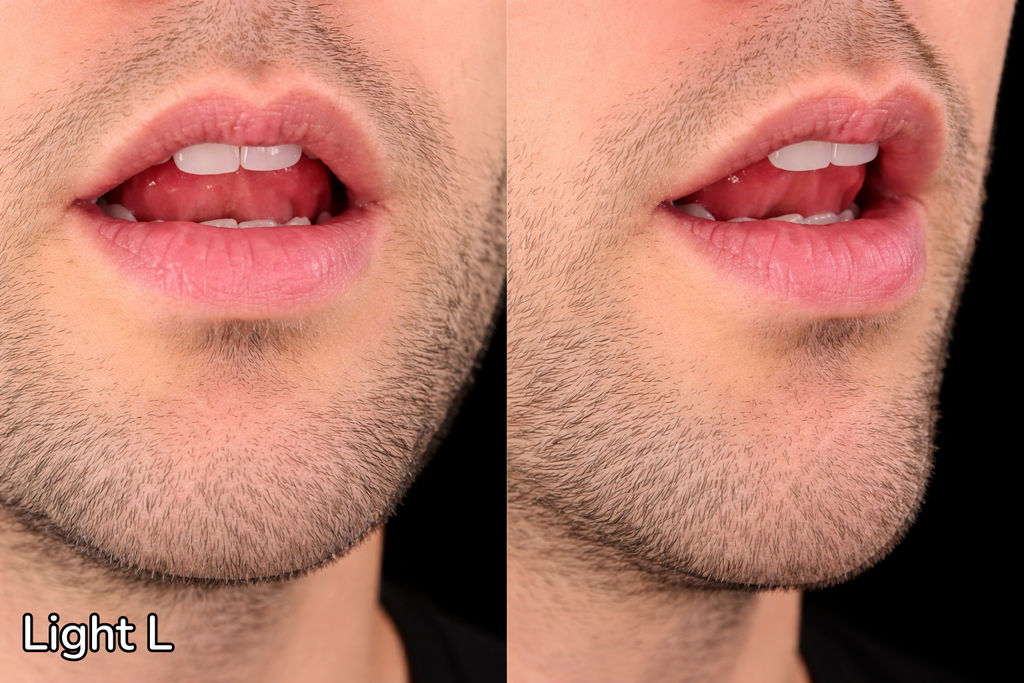
Mouth shape
/l/ as in let
Tongue
Tip touches the alveolar ridge just behind the top front teeth (apical contact). The sides of the tongue pull slightly inward so the air can flow freely down both side channels. For Dark L (syllable-final), the back of the tongue additionally raises toward the soft palate.
Lips
Relaxed and neutral, don't round or flare them. Lip rounding is what turns /l/ into /w/.
Jaw
Slightly open, neutral. The jaw doesn't do much work for /l/, the tongue does the lifting.
Two things to remember.
Light L is used before vowels, it's the 'normal' L most learners know.
Let the air flow continuously around the SIDES of your tongue. This is what makes /l/ different from T, D, and N, which block the air entirely down the middle.
Compare with similar sounds.
If your sound is sliding into a neighbor, here's how to tell them apart.
16 everyday words.
Tap any word for its full breakdown — every reduction, every flap-T.
In real conversation.
5 short sentences where this sound shows up. Tap to play; click the title for the full breakdown.
Connected-speech rules involving /l/.
Each rule has its own page with examples and practice tips.
Common questions about /l/.
What's the difference between Light L and Dark L in American English?
Why does my /l/ sometimes sound like a /w/ to Americans?
How do I stop mixing up /l/ and /r/?

Practice /l/ with an AI coach.
SayWaader is the AI pronunciation coach for American English. Practice 5 minutes a day. Get a 5-axes accent assessment. Sound like you live here.