You hear it. That’s the maddening part.
You say the word, and you can hear it going wrong even as it leaves your mouth. So you say it again, slower, more deliberate, watching for it this time, and it comes out wrong in the same place in the same way. Your ear is sitting right there, flagging the error the instant you make it, and your mouth simply will not take the note.
This is one of the most disorienting stages of changing how you speak, and almost nobody warns you about it. You assume that once you can hear a sound correctly, producing it is a short step away. Then you reach a word where you can hear the target perfectly, hear your own version clearly, hear the distance between them, and still cannot close it. It feels like a malfunction. It’s the opposite. It’s the sound of your ear having moved out ahead of your mouth, which is the order these things are supposed to happen in.
Being able to hear a sound you can’t yet produce is normal, and it’s a sign of progress rather than failure. Perception runs ahead of production in almost every motor skill, speech included: the ear learns to judge the target before the body can hit it. Your sense of the sound is sharpening faster than the muscle habit that makes it. Closing the gap takes the opposite of effort: sharpen the sound through focused, minimal-pair listening, produce it slowly and gently instead of straining, and give the motor habit the weeks it needs to catch up.
The uncomfortable stage nobody warns you about
When people picture learning a new sound, they picture a wall: you can’t hear it, you can’t say it, and one day both unlock together. Real learning has a stage in between that the wall image leaves out. You can hear it, in other people and increasingly in yourself, but your mouth still defaults to the old version. You have the judgment before you have the execution.
The discomfort has a precise shape. Before you could hear the difference, nothing bothered you, because you didn’t know anything was off. Ignorance was quiet. Now every attempt comes with its own live review: you produce the word, your ear grades it, and the grade is “still wrong.” The better your ear gets, the louder that review becomes. Plenty of learners read this as going backwards. They were comfortable a month ago and they’re frustrated now, so it feels like decline. It’s the discomfort of new perception switching on. You can’t be annoyed by an error you can’t detect.
So the first thing to do with this stage is to recognize it for what it is and stop treating it as evidence that you have no ear or no talent. The fact that the mismatch bothers you is proof the ear is working. The mouth is just on a slower clock.
Why perception runs ahead of production
There’s a reason the ear gets there first, and it isn’t unique to language. It’s how we learn almost any physical skill.
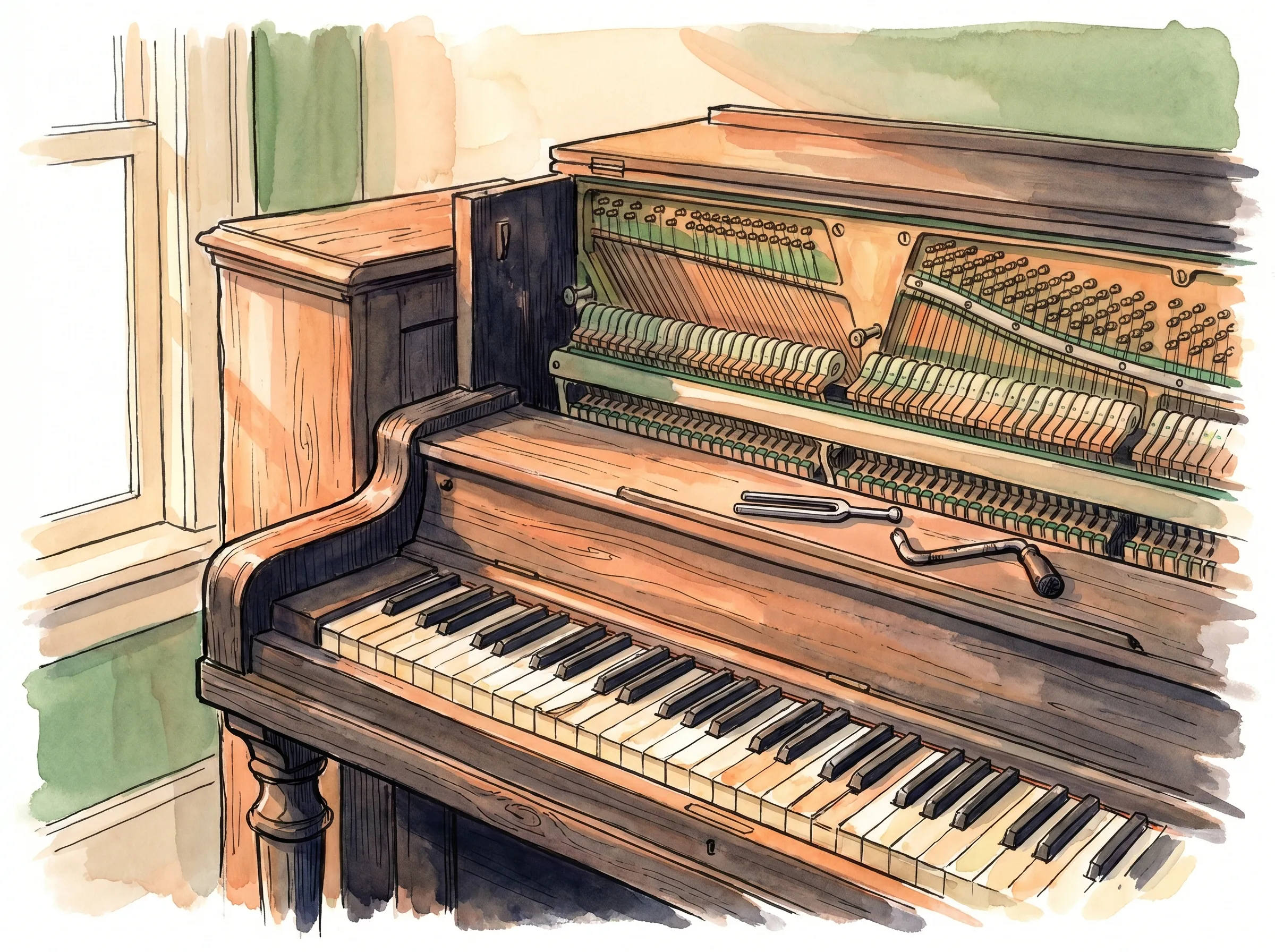
Think about anything you’ve ever learned to do with your body. You could hear a wrong note on a piano long before your fingers could reliably find the right one. You could see that one tennis serve was smooth and another was a flail well before your own arm could produce the smooth version. Recognizing a good result and executing it run on different systems, and recognition matures first. Speech is a motor skill like the others. Saying a sound is a fast, coordinated sequence of movements, the tongue, lips, jaw, and voice all hitting their marks within a fraction of a second. Knowing precisely how that sequence should sound doesn’t hand you the program that runs the muscles. That program gets built slowly, by repetition, the same way a serve does.
Speech carries a complication the tennis serve doesn’t. You’ve been running the old motor programs your whole life. Your first language installed a set of sound categories in infancy, and within your first year your brain had already tuned itself toward the contrasts that mattered in that language and away from the ones that didn’t. Those categories are not neutral. Researchers describe the sound categories of your first language as behaving like magnets: a new sound that lands near an existing category gets pulled toward its center, heard and produced as the familiar neighbor rather than the new thing it really is. This is why the hardest sounds are often not the wildly foreign ones but the near-misses, a target that sits close to a sound you already own. A genuinely new sound, with no neighbor to be mistaken for, can form a fresh category of its own. A near-miss gets grabbed by the old category and filed under the closest match.
The blind spot in your own voice
There’s a related trap that sits just underneath all this. The live error from the opening, the one your ear catches as it happens, is only the part loud enough to break through. Many of your errors aren’t. When you speak, your ear is a compromised monitor: your brain already holds a prediction of what you’re about to say, and in the rush of talking it leans toward hearing what you intended rather than what came out. The biggest mismatches still get through, which is why some errors sting in real time. The smaller ones slip past, and you walk away certain you nailed a word you actually missed.
A recording strips the prediction away. Played back, with no plan to defend, you hear the raw signal, and people are routinely startled by it: that’s not how I thought I sounded. This is why recording yourself does so much more than practicing into the air. It pulls your own production out of the blind spot and sets it in front of the same good ear that already works fine on other people. Plenty of learners can hear a contrast clearly in someone else’s mouth long before they can hear it in their own live speech. A recording is what bridges that gap. It stays useful long after, too, still catching what your live ear glosses over once you can flag some errors in real time.
Why pushing harder makes it worse
When the mouth won’t obey, the natural instinct is to push: tense the tongue, force the jaw, strain the throat, say it louder and harder as if effort alone could shove the sound into place. This almost always backfires, for two reasons.
The first is mechanical. Most new sounds need a small, precise, relaxed movement, and tension is the enemy of precision. A strained tongue is a clumsy one. When you bear down, you recruit muscles that have nothing to do with the target and you make the fine adjustment you’re reaching for harder. The second reason is about learning. Every time you force out a tense, distorted version of the sound, you’re still practicing something, and what you’re practicing is the tense, distorted version. Uncorrected, repetition grooves whatever you actually did, not what you meant to do. Ten strained attempts don’t add up to one clean sound; they add up to a strained habit you’ll later have to undo.
This is the part that feels unfair. The harder you try, in the most literal muscular sense, the worse the result, because effort and tension are nearly the same gesture in the body, and tension wrecks the movement. The way through isn’t to push harder. It’s to ease off, slow down, and listen more.
More listening, not more forcing
If straining is the wrong lever, what’s the right one? Mostly it’s your ear, used more deliberately. The counterintuitive finding from the research on this is that training perception improves production, sometimes with no production practice at all. In one well-known set of studies, Japanese speakers whose training was pure listening on the English /r/ and /l/ difference came out producing the contrast more accurately afterward, not perfectly, but measurably so, with no mouth practice at all. Sharpening the target in the ear gave the mouth something better to aim at.
The practical form of that is minimal-pair listening. A minimal pair is two words that differ by exactly one sound, so the contrast you’re training is the only thing in play. The pairs that give learners the most trouble are usually near-misses of the kind from earlier, close enough to a sound you already own that your ear keeps lumping the two together, which is exactly why pulling them apart by ear is worth the time.
| The contrast | Minimal pair | Who it trips up |
|---|---|---|
| /r/ vs /l/ | right / light | Japanese, Korean |
| /iː/ vs /ɪ/ | sheep / ship | Spanish, Arabic, many |
| /θ/ vs /s/ | think / sink | French, German, Japanese |
| /v/ vs /w/ | vine / wine | Hindi, German |
| /æ/ vs /ɛ/ | bad / bed | Spanish, Italian, many |
Work a pair like that by ear first. Find recordings of the two words from several different native speakers, not just one voice. A single voice only trains you to its particular quirks; the range across speakers is what teaches the contrast itself. Listen until you can tell the two apart every time without looking, even at speed. That’s the perception base, and for some learners it’s genuinely not solid yet even when they assume it is. Only once the two words are clearly different in your ear does production practice have a target worth aiming at.
When you do move to your own mouth, go slow. Drop it far below conversational speed, slower than feels natural, and produce the sound in something close to slow motion, feeling where the tongue is rather than rushing to the finish. Slowness does two things. It gives you time to monitor, to catch the movement going wrong while you can still correct it, and it loosens the grip of the automatic old program, which mostly fires at full speed. Then check yourself with a recording, compare it against the native version, adjust, and go again. A loop like that, slow and gentle and closely watched, is what changes the habit. Hammering out fast, tense reps just carves the old groove deeper. As the slow version becomes reliable, edge the speed back up toward conversational pace a little at a time, so the new movement holds when you actually talk.
Patience as an actual technique
Even doing everything right, there’s a lag between when your ear locks onto a sound and when your mouth can produce it on demand, and you can’t shorten it to zero by wanting it more. Motor habits consolidate on their own schedule. A movement you drilled today keeps settling in after you stop, partly while you sleep, and the gains often show up not in the session but a day or two later, which is why a sound you couldn’t get on Tuesday is sometimes just there on Thursday. Short, frequent practice spaced across days beats one long grinding session: something like ten focused minutes a few times a day will do more than a single ninety-minute push on the weekend, because the consolidation happens between the sessions, not during them. This is the same spacing effect behind every other kind of skill practice.
So patience here is not a consolation prize or a soft way of saying “keep at it.” It’s the correct technique. The gap between perception and production is a real interval with a real cause, and the work during that interval is to keep feeding the ear, keep the production gentle and slow, and let the habit set. Learners who understand that stop reading the lag as failure and stop forcing, which is what lets the lag close. The ones who panic at the gap and respond by straining are the ones who stay stuck in it, because the straining itself is part of what holds the old sound in place.
If you want the wider view of how long these changes take across all your sounds, the timeline article lays out the weeks and months involved.
Reader questions
Because hearing a sound and producing it run on different systems, and the hearing system matures first. Recognizing that a sound is right is perception; making it is a motor skill, a fast coordinated movement of the tongue, lips, jaw, and voice. In almost every physical skill the ability to judge a good result shows up before the ability to perform it, the same way you can hear a wrong piano note before your hands can reliably play the right one. Being able to hear a difference you can’t yet say is normal and means your ear has moved ahead of your mouth, not that you lack talent.
Generally yes. You need a clear sense of the target in your ear before your mouth has anything accurate to aim at, and for many learners the perception is still not as solid as they assume. Building an accurate mental model of the sound, through focused listening and minimal-pair practice, tends to be the prerequisite that makes production practice pay off. This is also why training that targets the ear often improves spoken production.
Yes, and the effect is well documented. A minimal pair is two words that differ by a single sound, like right and light or sheep and ship, which isolates the one contrast you’re training. Lab studies have found that learners drilled purely on perceiving a difficult contrast often produce it more accurately afterward, even without practicing the production directly, because a sharper target in the ear gives the mouth something better to aim at. For pronunciation, listening does a large share of the real work, not just a warm-up before it.
Because most speech sounds need a small, relaxed, precise movement, and tension destroys precision. When you bear down, you tighten muscles that aren’t involved in the target and make the fine adjustment harder. You’re also practicing whatever you do, so forcing out a tense, distorted version grooves that tense version as a habit. The fix is to produce the sound slowly and gently while checking it against a model, rather than trying to overpower it.
Because while you’re speaking, your brain is partly hearing what it expected to say rather than what you produced. Your own motor plan and expectation cover the gap in real time. A recording removes that cover and lets you hear the raw signal, which is why people are so often surprised by their own playback. Recording yourself and listening back is the most reliable way to move your own voice out of that blind spot and judge it with the same ear you already use on everyone else.
It varies by the sound and by how far your perception and motor habits have to move, but it’s usually weeks of short, frequent practice rather than days. Motor habits consolidate between practice sessions, partly during sleep, so practice spaced across many days works better than one long push, and progress often appears a day or two after a session rather than within it. The interval is real and has a cause, so the useful response is to keep practicing gently and let the habit catch up, not to strain against it.
The gap between what you can hear and what you can say is the clearest sign you get that something is genuinely shifting. It only appears once your ear has outgrown your mouth, and it only closes when you stop trying to force the two back together by sheer effort. Keep the listening sharp, keep the practice slow and quiet, and treat the wait as part of the method rather than a sign it isn’t working. Give it the weeks it needs and the mouth follows. It was always going to be slower than the ear; that’s the order these things happen in.