G /g/ and K /k/ are made with exactly the same tongue movement: the back of your tongue lifts to block air at the roof of your mouth. The difference is voicing. /g/ vibrates your vocal cords (you can feel a buzz in your throat), while /k/ is just air. At the start of a stressed syllable, American /k/ also gets a strong puff of breath called aspiration. If you don't add that puff to cat, Americans might hear gat instead.
How the two sounds differ.
3 small mouth adjustments. Get any one of them wrong and the sound slides into its neighbor.
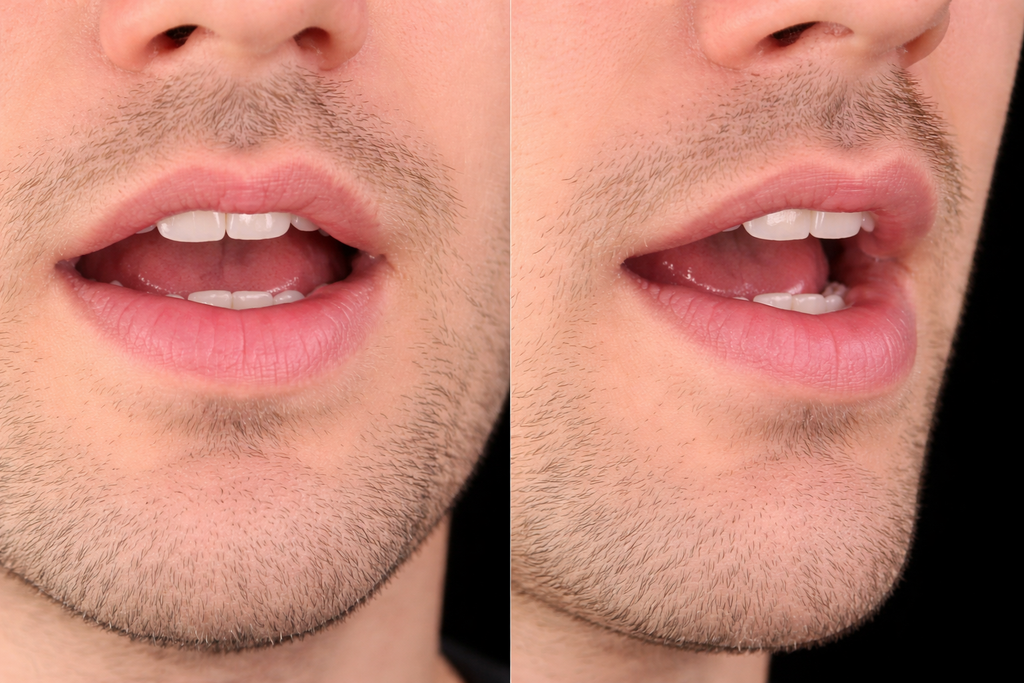
Now you try.
Record yourself saying "Got" and "Cot" a few times. Listen back — your own ear is the best feedback for nailing the contrast.
Words that change with one sound.
Every pair below differs by exactly one sound: flip /g/ to /k/ and the meaning flips with it. Tap any word for its full breakdown.
If your ear blurs them, here's why.
Two things trip people up here. Languages like Spanish, Russian, and French don't add a puff of air (aspiration) to their /k/. When speakers of these languages say coast without that puff, American ears often mishear it as ghost, because an unaspirated /k/ sounds like an American /g/. German and Russian also have a rule called "final devoicing" that automatically turns a voiced /g/ into a voiceless /k/ at the end of a word, making bag sound exactly like back. In American English, the contrast at the end of a word is mostly carried by the vowel before the consonant, not by the consonant itself. We stretch the vowel out before /g/ and cut it short before /k/, even though the final /g/ is often quietly held with little or no audible buzz.
Train the muscle, then the ear.
3 short drills. Do them out loud: feel the change inside your mouth before you try to hear it.
Hold a piece of paper an inch from your mouth. Say coat, cat, keep. The paper should flutter from the puff of air. Now say goat, gat, geese. The paper should barely move.
Check your throat buzz where it actually shows up: between vowels. Put your fingers on your throat and say a-g-a, like you're saying the middle of ago. The buzz should run continuously straight through the middle consonant. Now say a-k-a; the buzz briefly stops when your tongue goes up for the K. (Trying to sustain a long g-g-g at the start of a word doesn't work; voiced stops naturally choke off in under a heartbeat once the air is sealed in.)
Practice final consonants by stretching the vowel. Say back quickly. Now say bag, but hold the vowel sound twice as long before finishing the word. American ears lean on this vowel length to tell them a /g/ is coming.
Common questions about Got vs Cot.
Why do people think I'm saying "goat" when I say "coat"?
How do I pronounce G and K at the end of a word?
Is the "hard C" the same sound as K?

Master Got vs Cot with an AI coach.
SayWaader is the AI pronunciation coach for American English. Practice 5 minutes a day. Get a 5-axes accent assessment. Sound like you live here.